
It was happening again.
I’d been working with the executive team of a regional water authority, helping them land on a set of strategic focus areas so they weren’t trying to do everything at once. We’d just finished our second deep dive, synthesising the strategic contributions into a ten-year-plus strategy.
The same ten themes surfaced. It stared back at us the moment we pulled up the visual output from the first session. Worded slightly differently, but strip away the language and the concepts underneath were almost identical to round one. And every single one of them still seemed important. We hadn’t managed to shortlist a thing. So much for getting to a focus of three to five areas.
Someone suggested merging a few themes together. But merging isn’t prioritising, it’s just renaming. We weren’t making a single real trade-off.
It was actually pretty funny, in a resigned sort of way. We stood there with our hands on our hips (metaphorically) and looked at each other. Now what?
That moment became the catalyst for a proper prioritisation reckoning. How do you prioritise when everything is a priority? One question kept surfacing in the group discussion: where do we actually have choice? I liked that question a lot. But it also nagged at me that we couldn’t just wave away the compliance obligations, the operational must-dos, the mandatory priorities that government sets for every public sector organisation. Ignore those and you’re not doing strategy, you’re creating risk.
That got me curious about scale. How much organisational capacity would those non-negotiables actually eat up, and what would be left over for the choice? And once we knew what was left, how would we separate the priorities where we genuinely had a say from the ones where there wasn’t much to do yet, or weren’t even fully known, but still needed watching so they didn’t blindside us later?
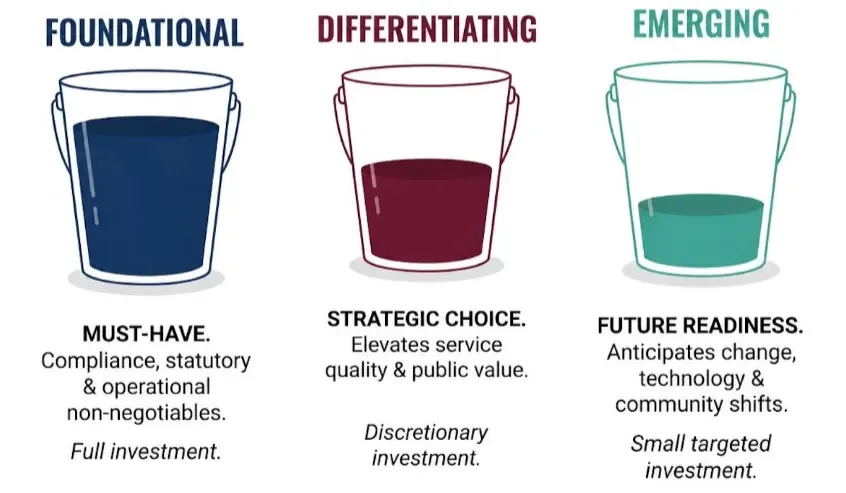
Three questions. Three buckets. That’s where the priority logic at the heart of this framework was born: Foundational, Differentiating and Emerging.
It isn’t unique to water utilities. Every strategic planning meeting runs into the same problem. Everything feels important. The list of priorities keeps growing, but the resources don’t. The question that matters most isn’t “What should we do?” It’s “Where do we actually have a choice?”
The hard part of strategy is deciding what actually gets the investment: the budget, the extra resourcing, the leadership attention. The priority list is long, and almost impossible to argue with: customer experience, digital transformation, workforce capability, regulatory compliance, cybersecurity and privacy. Each one is valid. Each one has a vocal champion somewhere in the building.
That’s where most strategy processes quietly break down. The strategic thinking is there, but it never turns into real trade-off decisions. Michael Porter said it best: the essence of strategy is choosing what not to do. It isn’t a shopping list of everything that sounds important.
That hard line, between what an organisation must do and what it chooses to do, runs through everything that follows. Without it, everything competes with everything else. You end up with a strategy that tries to do all of it (and does none of it well), or a long, exhausting fight over which priority gets to win.
Starting with the non-negotiables
The first job for a leadership team is to pull out the non-negotiables. Not to dismiss them, but to stop pretending they sit in the same category as everything else.
Every organisation carries obligations that are mandatory, not optional: regulatory requirements, statutory duties, safety and compliance standards, the infrastructure that simply has to be kept running. I call these Foundational priorities. There’s no debate about whether to invest. Skip them and you’re looking at regulatory non-compliance or a service delivery failure. They get funded first, and the timing isn’t really yours to set.
Naming this category early changes the whole conversation. It takes a big chunk of the agenda off the table before anyone can argue it’s “up for discussion”. What’s left once the Foundational priorities are funded, that’s where the real strategic choice lives.
Where the real choice begins
What’s left once the non-negotiables are out of the way splits into two further categories, and each one calls for a different level of investment.
Differentiating Priorities
These are the strategic choices that lift service quality and create public value beyond what the organisation is required to deliver. This is where real strategic leadership shows up: deciding which priorities to back, and how far to back them. The level of ambition here is a leadership call.
Take a public housing authority. It could meet the minimum community engagement obligations, or it could invest properly in co-design with tenants. Both are compliant. One is box-ticking. The other gets you housing built with, and for, the community that lives in it. Differentiating priorities like this typically warrant somewhere around 20 to 30 per cent of available strategic investment, and every dollar spent on one comes at the expense of another.
Emerging Priorities
These look forward. They build readiness for what’s coming, technology shifts, policy changes, demographic change, evolving community expectations, or they hold open space for something you can’t yet name. They warrant a smaller initial investment, somewhere around 10 to 15 per cent, but protecting that investment is what keeps an organisation alive in the long run. Skip it, and you end up reactive, forever chasing the horizon instead of watching it.
The research backs this up, and it plays out differently in the public sector than in private business. Hansen and Ferlie (2016), looking at strategic frameworks in public sector organisations, found that mandatory obligations and genuine strategic choices operate in fundamentally different ways than they do in a private sector context. Frameworks need to reflect that. Agile portfolio management is one route in. Ononiwu and colleagues (2025) found that techniques like value stream mapping and participatory budgeting give public sector portfolios something they usually lack: a transparent, ongoing way to reprioritise as circumstances change, instead of a fixed list drawn up once a year and defended regardless of what happens next.
Timing is a choice too
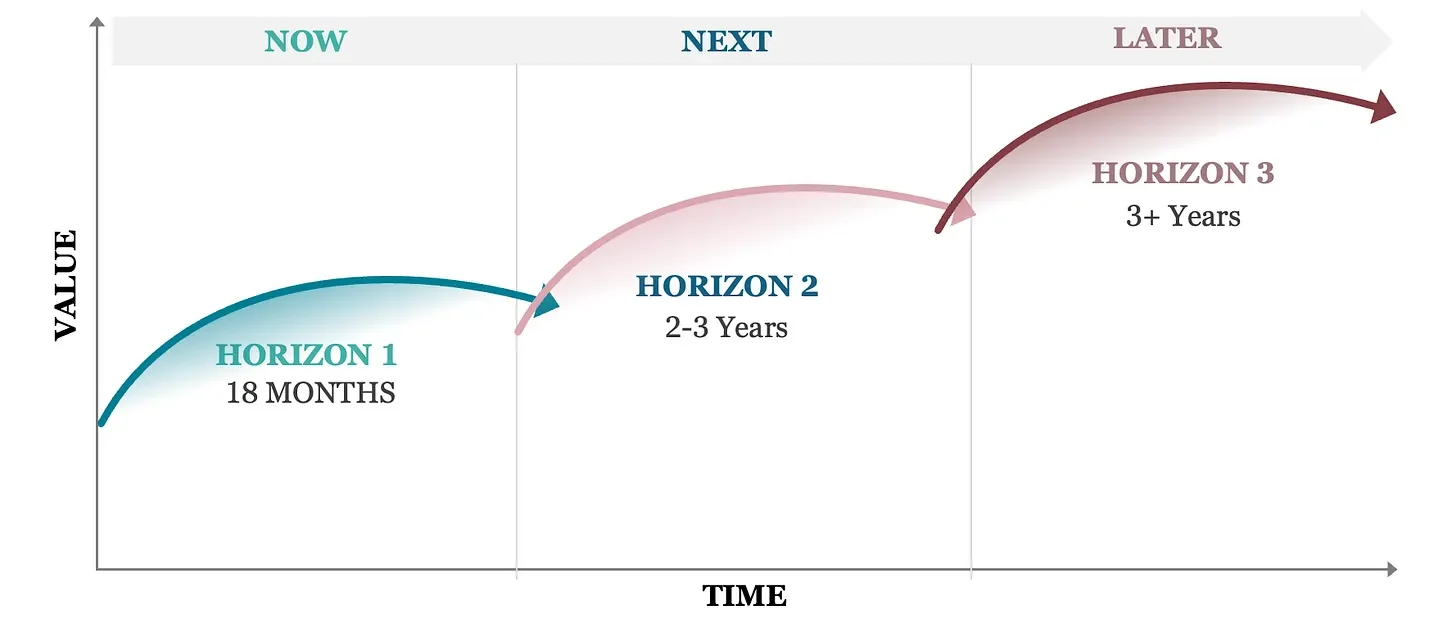
Naming the three priority types tells you what to invest in. It doesn’t tell you when. That’s where the Three Horizons approach earns its place, helping leaders sequence investment across what needs attention now, what comes next, and what can be deliberately planned for later. Get the split right across Foundational, Differentiating and Emerging priorities, and you’ve got a road map with realistic timeframes instead of wishful ones.
Horizon 1 (the next 18 months) covers immediate compliance, the core initiatives with clear impact, and the actions that can’t wait.
Horizon 2 (one to three years) is where the major improvement initiatives sit, alongside scaled pilots and the regulatory changes you can already see coming.
Horizon 3 (three-plus years) holds the experimental bets, the long shots that might become Differentiating or even Foundational priorities down the track, but aren’t yet.
The real strength of the Three Horizons model is that it gives leaders permission to say “yes, and later” instead of forcing a binary yes or no. A priority that belongs in Horizon 3 doesn’t have to win this year’s budget debate. It has a place, and it has a time.
You can view the complete PDF with these frameworks attached below:
Changing the conversation about choices
Ranking strategic themes in order of importance almost always stalls the room. Classifying them works better. Foundational priorities mostly identify themselves; they come off the table quickly, without debate, which frees the conversation to focus where it should, on the Differentiating priorities. The question there was never whether a priority matters. It comes down to how much you’re prepared to invest in it.
Phillips and colleagues (2007) found that organisations make far stronger prioritisation decisions when they set explicit criteria before comparing options, not after. Most teams skip straight to comparing two or three choices that were already obvious, instead of mapping the full range of options and agreeing on how to judge them first. The criteria, if they exist at all, get built afterwards, shaped to justify whatever option was already winning the room. The three-category model gives the room a criterion-based way in. It shifts the question from “which priority matters more” to “what type of priority is this, and what does that tell us about how we fund and sequence it?”
The goal in these sessions is majority consensus with commitment, not unanimity down to the last detail. That distinction matters. The strategic intent, the “what”, needs to be agreed in the room. The implementation detail, the “how”, can be worked out later. It doesn’t need solving in the same room.
Building trust through better choices
There’s a harder conversation sitting underneath all of this. The difference between organisations that have built meaningful decision-making criteria, and organisations still allocating resources to whoever argues loudest, or whoever has the most historical precedent on their side.
People commit to a decision far more readily when they understand how it was made. Make the reasoning clear, transparent and shared, and stakeholders back the outcome. Mukhtar and colleagues (2021) found that frameworks bringing together different stakeholder perspectives when classifying priorities lead to better outcomes and stronger commitment to implementation.
That’s not just an efficiency argument. It’s an argument about culture and trust.
Leaders are being asked to balance more competing demands, with fewer resources, under more scrutiny than they’ve ever faced. The organisations that get this right won’t be the ones with the longest strategy documents or the most stakeholder sessions. They’ll be the ones that understand where genuine choice actually exists, and make those choices deliberately, transparently and consistently.
Every framework in this piece points to the same discipline: finding where the trade-off actually sits. The most important question in strategy was never “What should we do?” It’s “Where do we actually have a choice?”, and having the nerve to make that choice once you’ve found it.
If this framework is relevant to work you’re doing, book a call or reach out directly: jo@joclancy.com.au

Forwarded by a colleague? Get these strategy insights in your inbox every month. Subscribe here;
Ready to book a complimentary chat?